

Native vs. React Native in 2026: A Practical Decision Framework
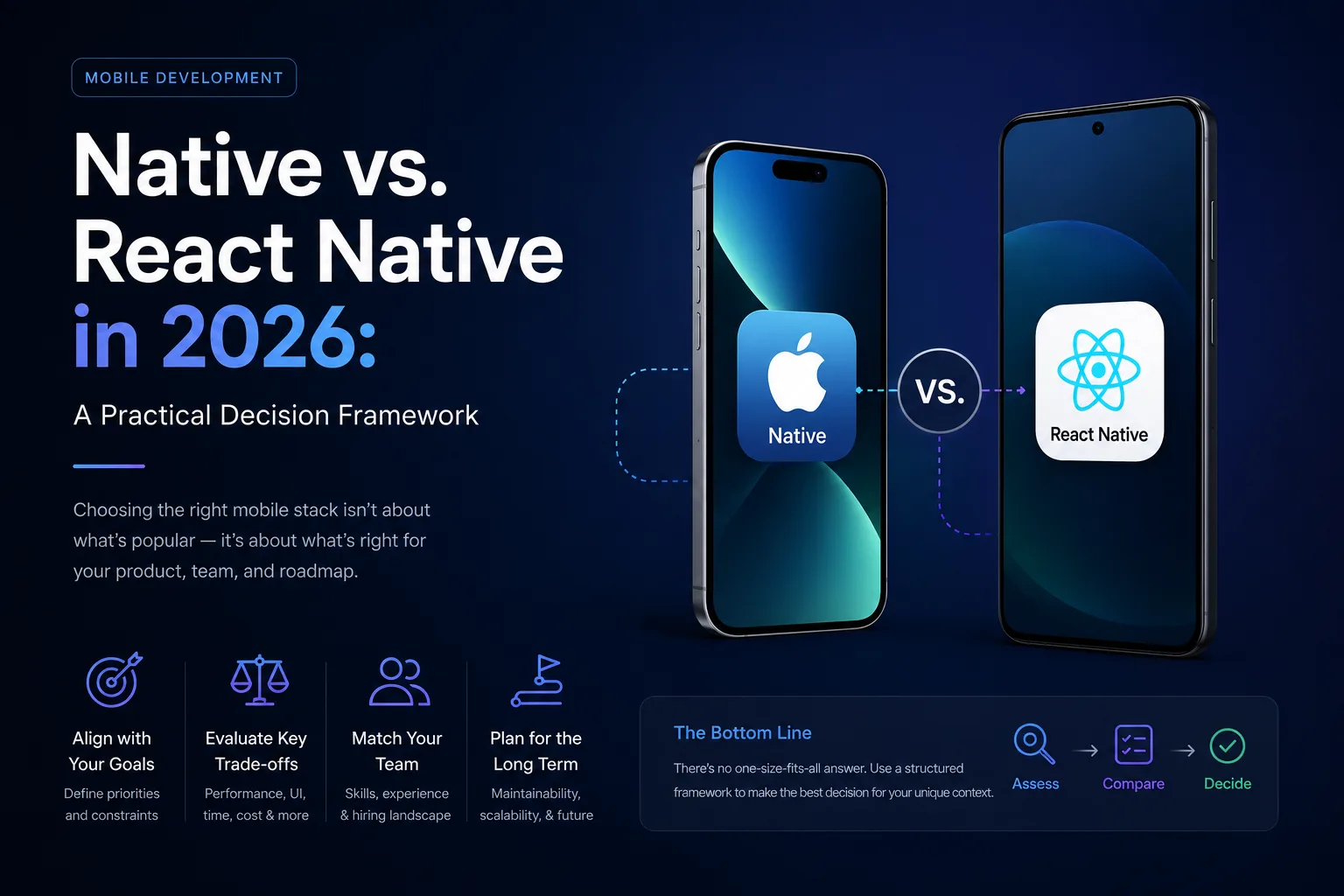
Clients usually come to this conversation with a strong opinion already — "we want it native, it's faster" or "just use React Native, it's cheaper." Both are true often enough to be dangerous as defaults. Here's how we actually decide.
The question that matters more than the tech
Before performance or cost, we ask: how much of this app's value depends on things the OS controls tightly? Camera pipelines, background processing, ARKit/ARCore, complex animations tied to native gesture systems — these are where React Native's bridge still adds real friction, even with the new architecture. If your app is mostly forms, lists, API calls, and standard navigation, that friction barely shows up.
Where React Native wins outright
- Team size under four engineers. One codebase means one set of PRs to review, one release pipeline, one set of bugs.
- iOS and Android need to ship in the same sprint. Native means doubling the team or doubling the timeline — there's no third option.
- The product will change fast for the first year. Hot reload and a shared business-logic layer mean pivots don't cost you two implementations.
Where native still wins
- The app is the differentiator, not the business logic. If users are paying for buttery scroll performance or platform-specific interaction patterns, native gives you headroom React Native makes you fight for.
- Heavy background work. Long-running location tracking, complex audio processing, or anything that needs tight control over OS lifecycle events is still more predictable in Swift/Kotlin.
- You're building a platform, not a single app. SDKs, widgets, and deep OS integrations (Live Activities, App Clips, Android Auto) are native-first by design.
What we don't recommend anymore
Flutter for client work, unless the client already has a Flutter team. Not because it's bad — because the hiring pool is smaller, which becomes your problem eighteen months after launch when you need to grow the team.
The framework, condensed
We score every mobile app development engagement on three axes before recommending a stack: platform-specific complexity, team size and hiring plan, and how fast the product needs to change in year one. Two out of three pointing toward "standard app, small team, fast iteration" means React Native. Two out of three pointing toward "platform-heavy, dedicated team per OS, stable scope" means native. Most projects aren't close calls once you actually score them — the debate feels harder than the decision usually is.
Mobile App Development
Native iOS and Android apps, or one React Native codebase for both.
Learn more →More from the blog.
Get insights delivered monthly.
One email a month — no fluff, just what we're learning from building software for clients.