

The CRM Fields Nobody Uses (And What to Build Instead)
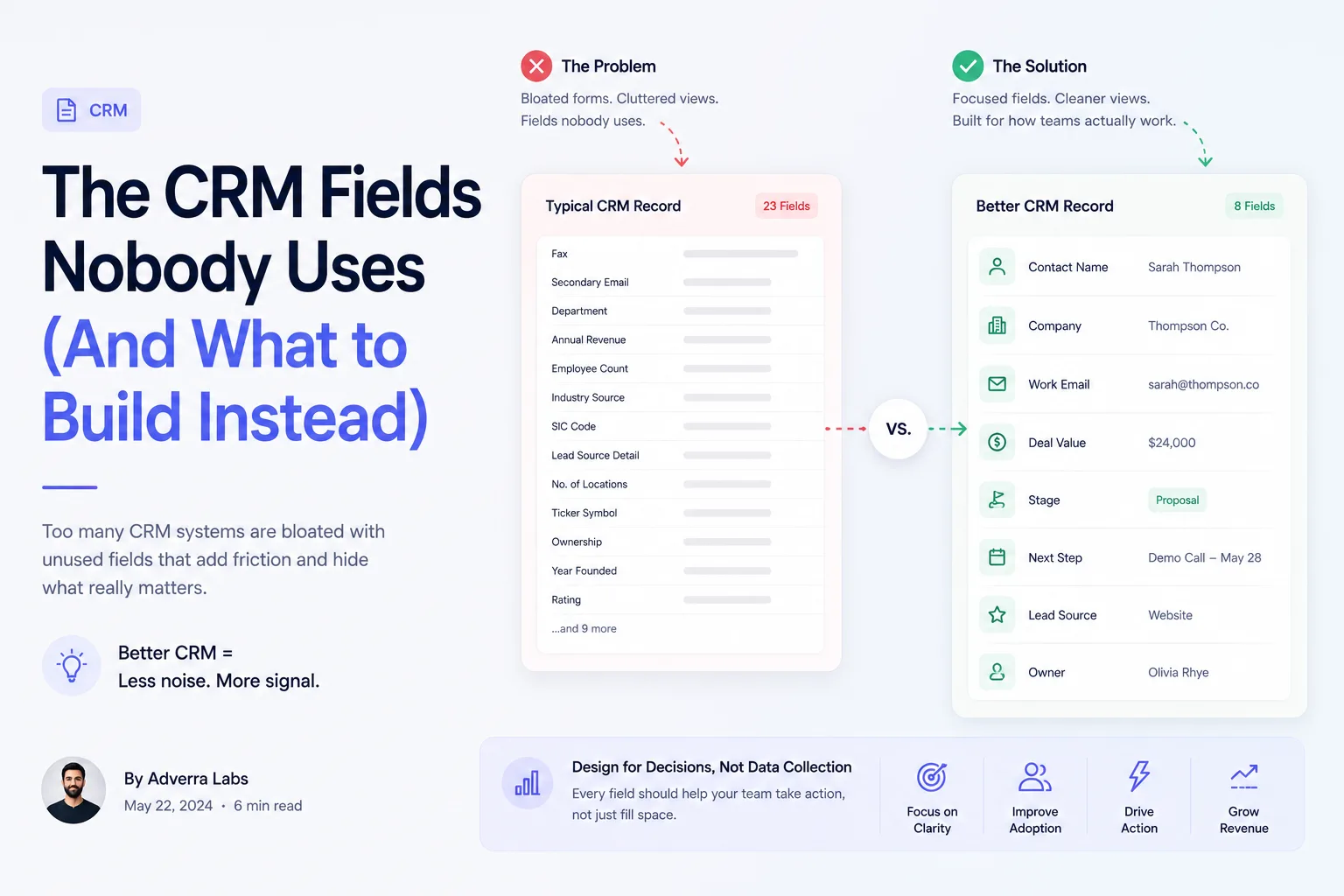
Before we build a custom CRM, we ask for read access to the old one. Almost every time, the pattern is identical: fifty-plus fields on the contact record, and reps are filling in maybe twelve of them consistently. The rest is either blank or filled with garbage data to get past a required-field validation.
Why this happens
Off-the-shelf CRMs are built to sell to every industry at once, so every field a sales-ops consultant has ever wanted gets added to the default template. Nobody removes fields once they exist — deleting a field feels riskier than leaving it unused. Three years later, the data model reflects nobody's actual process.
What we actually find reps using
Across the audits we've run, the fields that survive contact with real usage are consistently the same:
- Deal stage — but usually a custom set of 4-6 stages, never the default 10+.
- Next action + date — the single field that predicts whether a deal gets followed up on.
- Deal owner — obvious, but often broken by territory reassignment logic nobody maintained.
- Source — where the lead came from, because marketing needs it for attribution.
- A free-text notes field — reps write context here that no structured field captures well.
Everything else — the twenty custom dropdowns for industry sub-vertical, company size bucket, referral chain, and so on — gets filled in once at import and never touched again.
What we build instead
Rather than starting from a template, we sit with the sales team and map their actual pipeline stages first — usually four to six, matched to real decision points, not generic "Prospecting → Closed Won" defaults. The data model gets built around that pipeline, not the other way around.
We keep the schema deliberately lean at launch:
- Core fields the pipeline stages actually require.
- One or two fields marketing needs for attribution.
- A notes field, because forcing structure onto every piece of context reps want to capture is how you end up back here in three years.
New fields get added when a real workflow needs them — not speculatively, not because a template included them.
The result
Smaller data model, higher fill rates, and reports that reflect what's actually happening in the pipeline instead of what a template assumed every sales team looks like. The CRM stops being a compliance chore and starts being the tool reps actually update, which is the only version of a CRM that produces trustworthy reporting.
CRM Development
A CRM shaped to your sales process — not the other way around.
Learn more →More from the blog.

Get insights delivered monthly.
One email a month — no fluff, just what we're learning from building software for clients.